
gravity.integration v4 is hereDownload nowSee what's new (opens in a new tab)

Case Studies

Tiptopol logo

TIP-TOPOLLogistics automation in the automotive industry

Company:
TIP-TOPOL Sp. z o.o. | Pobiedziska, Wielkopolska
Industry:
Automotive — manufacturing and distribution of workshop equipment, pneumatic diaphragms and wheel balancing weights
Headcount:
200–500 employees
ERP system:
Graffiti.ERP

Challenge

As Poland's largest manufacturer of wheel balancing weights and diaphragms for pneumatic suspensions, TIP-TOPOL ships hundreds of orders a day to customers across Poland and Europe. Handling those orders meant logging in to the courier operators' panels by hand — DPD, InPost, GLS — copying address data, generating waybills and tracking shipment statuses in separate systems. At TIP-TOPOL's scale that meant hours of administrative work every day, a risk of mistakes, and delays in telling customers where their delivery stood.

Solution

With gravity.integration we connected TIP-TOPOL's Graffiti.ERP system directly to the logistics operators' APIs. The ESB data bus automates the entire process:

  • Automatic waybill generation — order data from the ERP goes straight to the courier's system, with no retyping
  • Real-time status updates — dispatch, delivery and problem notifications flow back into the ERP automatically
  • Many operators handled from one place — DPD, InPost, GLS and Allegro connected through a uniform REST API
  • Label printing from inside the ERP — the warehouse worker never leaves the system they work in

The deployment took a few days and required no changes to the company's existing IT infrastructure.

Animation of the gravity.integration integration with the DPD system

Results

  • No more manual data entry into courier panels
  • Fewer mistakes in addresses and shipment data
  • Faster order handling — from placement to dispatch
  • Full visibility of every shipment's status in one system
  • Further operators can be connected at no extra integration cost

Logistics operators' logos — DPD, InPost, DHL, UPS, FedEx
Kapitan Navi logo

KAPITAN NAVIAutomating time-and-attendance registration with the Roger RCP system

Company:
Kapitan Navi | Trzebiatów, Zachodniopomorskie
Industry:
Fish processing — producer of marinated herring
ERP system:
Graffiti.ERP
Time-and-attendance (RCP) system:
Roger (MSSQL database)

Challenge

Kapitan Navi uses the Roger access control system to record employees entering and leaving the production zones through RCP gates (turnstiles and interlocks). The Roger data accumulated in an MSSQL database, but analysing it meant manual exports, spreadsheet work and cross-checking against the ERP's records. Production managers had no quick view of actual working time, break lengths, or whether employees were clocking at the right gates.

Solution

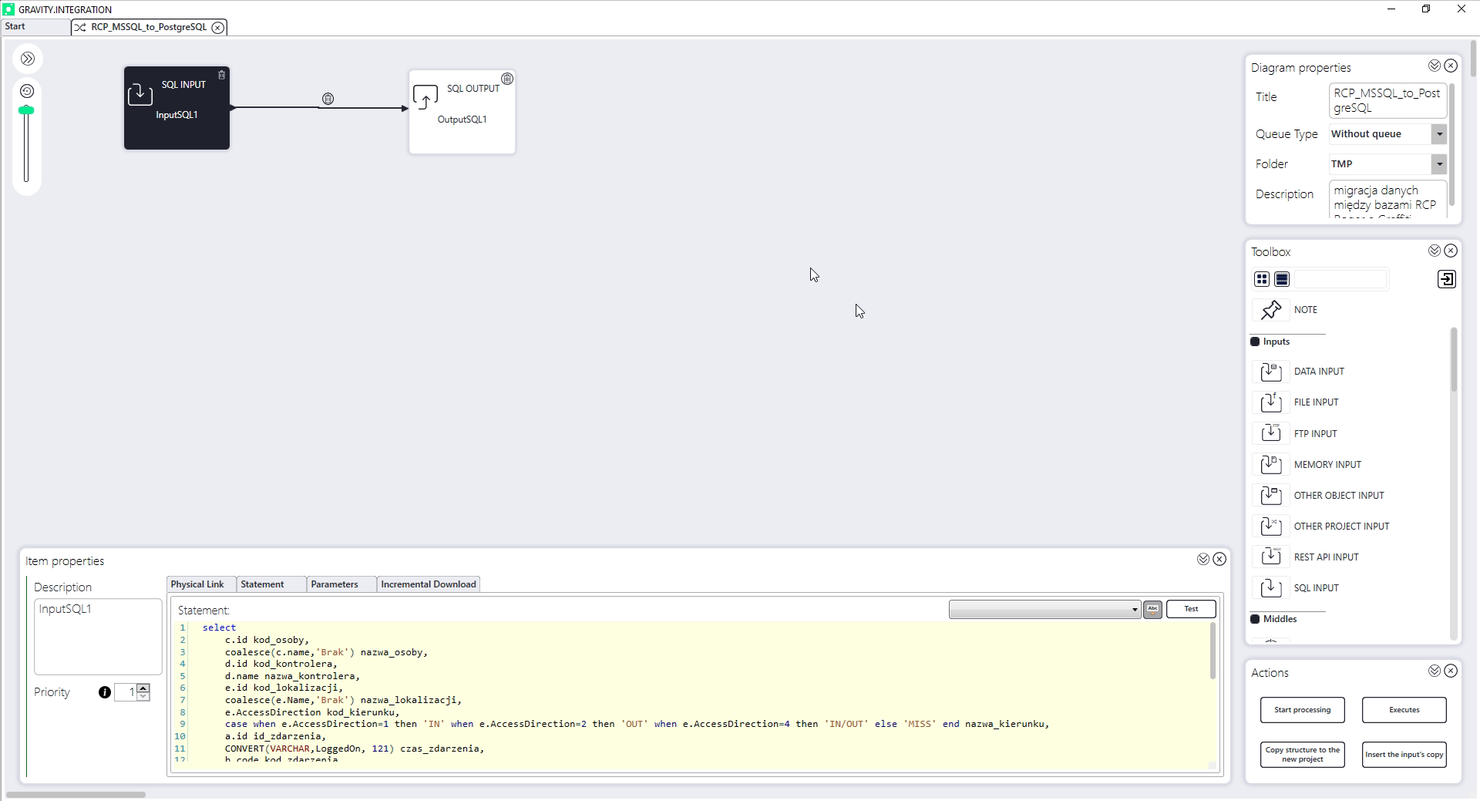
gravity.integration connected the Roger system's MSSQL database with the Graffiti.ERP system's PostgreSQL database through two ESB projects:

  • Real-time RCP data migration — raw data from the Roger readers is pulled every minute, filtered by the selected gates (turnstiles and interlocks) and written into the Graffiti database
  • Automatic processing by a SQL algorithm — a SQL function processes the raw readings to the client's rules: classifying work and break periods, identifying entry and exit gates, totalling times
  • Visualisation in the Grafbuilder module — the processed data lands in an analytics panel where the reviewer sees everything in one place
  • Report generation — daily and detailed RCP reports available instantly, with export to Excel
Roger RCP system logo

Results

  • A fully automated RCP data flow — from the Roger readers straight into Graffiti.ERP with no manual intervention
  • Data refreshed every minute — the production manager sees the current state in real time
  • Detailed working-time analysis: time in the production zone, break time, correct gate clocking
  • Ready-made RCP reports — daily and detailed — generated with one click from Graffiti.ERP
  • No more manual exports and spreadsheet processing
Data flow diagram in gravity.integration ETL
Logo firmy ELMET Poznań S.A.

ELMET Poznań S.A.Integrating BaseLinker multichannel sales with Graffiti.ERP

Company:
ELMET Poznań S.A. | Poznań, Wielkopolska
Industry:
Electrical engineering — distribution of electrical materials and equipment
ERP system:
Graffiti.ERP
OMS platform:
BaseLinker

Challenge

ELMET Poznań sells across many channels — orders arrive simultaneously from the BaseLinker platform, which handles the marketplaces and online stores, and directly in the Graffiti.ERP system. Without automatic synchronisation that meant retyping orders by hand, stock discrepancies, trouble pairing shipping and payment methods between the systems, and delays in telling customers how their order was progressing. With sales channels multiplying and delivery methods ranging from courier to personal pickup, manual handling was becoming the bottleneck of the whole process.

Solution

gravity.integration talks to the BaseLinker API, fetching orders, customer data and delivery methods, then processes them and writes them into Graffiti.ERP. The whole process runs fully automatically:

  • Automatic order collection from BaseLinker — gravity.integration projects poll the BaseLinker API and fetch new orders together with their line items, address data and shipping method
  • Intelligent shipping mapping — the Grafbuilder module pairs BaseLinker shipping methods with their Graffiti.ERP and WMS counterparts; missing methods are created automatically
  • Automatic dictionary maintenance — when a business partner is missing in Graffiti, gravity.integration pulls their data from the VAT whitelist (NIP validation through the Graffiti DLL) and creates a new record
  • Payment method pairing — missing payment methods are created automatically in Graffiti so they match the invoice
  • Fulfilment feedback — the order's status in Graffiti (picking, dispatch, invoicing) flows back to BaseLinker in real time

Results

  • A fully automated order flow from BaseLinker into Graffiti.ERP — no manual retyping
  • Missing business partners created automatically, with their data validated against the VAT whitelist
  • Consistent shipping and payment methods across the systems — paired, with missing entries created automatically
  • Customers always see their order's current status thanks to the feedback from Graffiti
  • Scalability — further marketplaces and sales channels can be added with no extra integration work
NAC — New American Concept logo

NACIntegrating the cStore e-commerce platform with Graffiti.ERP

Company:
NAC
ERP system:
Graffiti.ERP
E-commerce platform:
cStore (B2B/B2C)

Challenge

Multichannel sales on the cStore platform require constant, consistent data exchange with the Graffiti.ERP system. Orders, stock levels, price lists, product indexes and business partner data have to agree on both sides — otherwise you get discrepancies in product availability, out-of-date prices for individual pricing groups, and orders retyped by hand. B2B customers add extra complexity: every pricing group has its own terms, part of the assortment needs quantities reserved for specific partners, and a customer using the platform expects the full history of their orders — whatever channel they were placed in. As the number of partners and product indexes grew, manual synchronisation was becoming the sales process's bottleneck.

cStore e-commerce platform logo

Solution

gravity.integration exposes a ready-made, externally published webservice (API) — with a set of methods the cStore platform calls directly. It is the external system that queries the gravity.integration API whenever it wants to push or pull data from Graffiti.ERP, which keeps the exchange consistent and controlled. The synchronisation covers (→ to cStore, ↔ two-way):

  • Customer orders (↔) — adding the order header with its line items; in return cStore fetches all of a partner's orders regardless of channel (including those entered outside the platform), presenting complete information based on pricing groups (filter: the B2B partner list)
  • Stock records — quantities (→) — sales plans by pricing group: calculating the reserved quantity for B2B customers in a given group and the free quantities available to everyone (B2B/B2C)
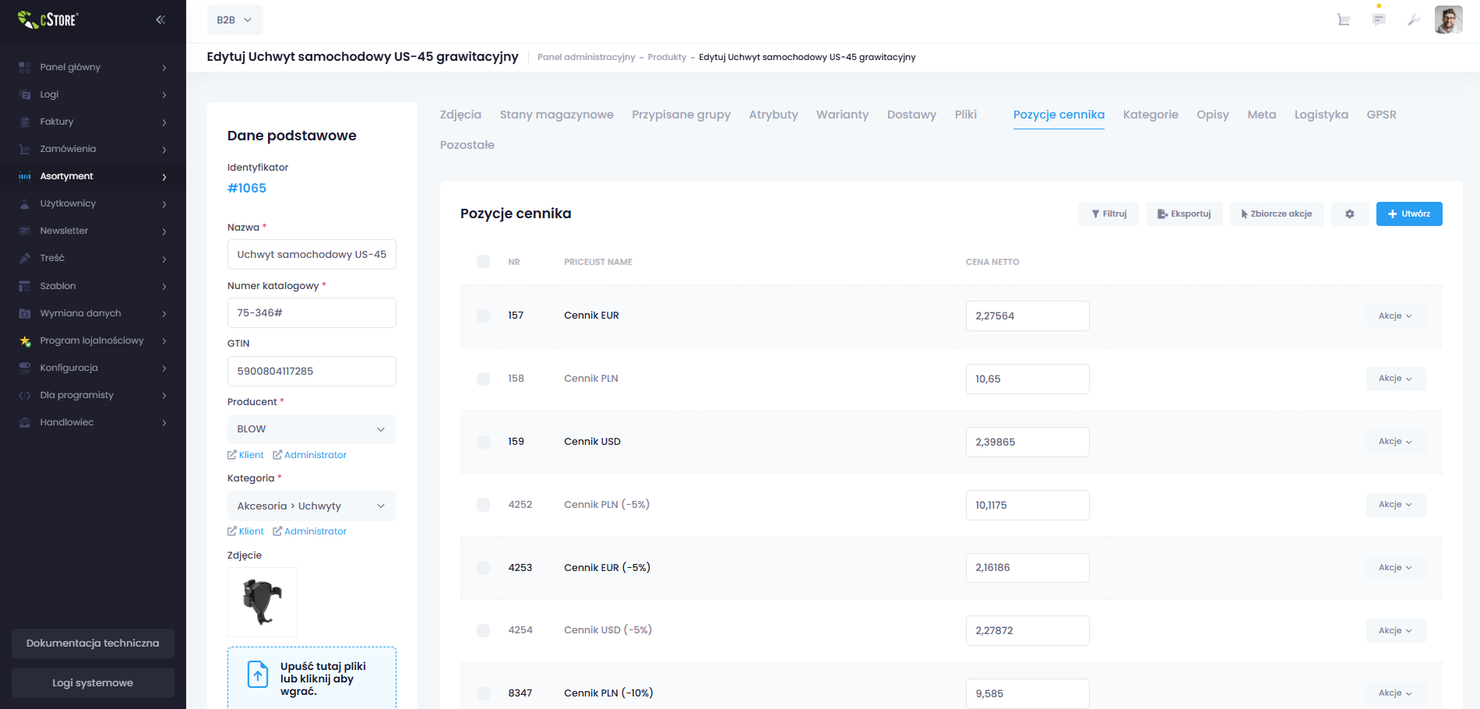
  • Price lists (→) — pricing groups correlated with partner records and product indexes
cStore admin panel: product price list entries (pricing groups) synchronised with Graffiti.ERP by gravity.integration

The Grafbuilder module

The remaining data — and the orchestration of the whole process — is handled by the in-house Grafbuilder module. The synchronisation is completed by:

  • Indexes and business partners (→) — pushed to cStore as the basis of the catalogue and pricing permissions
  • Sales invoices (←) — invoice information with on-demand PDF download from the platform; the printout is generated in the Graffiti.ERP-compliant variant (through the DLL)
  • Warehouse documents (←) — passed from Graffiti.ERP to cStore

Once an order arrives from cStore and its data has been processed, it lands in Graffiti.ERP. Grafbuilder builds the sales plans for B2B partners — together with the SQL views, triggers and functions (among them stock-limit checks and reservation priorities for orders).

Results

  • Fully automated data exchange between cStore and Graffiti.ERP — no manual retyping of orders or documents
  • Stock and prices consistent in real time, including pricing groups and reserved quantities for B2B customers
  • One complete view of a partner's orders on the platform — whatever the sales channel
  • Invoices (PDF in the Graffiti variant) and warehouse documents available to the customer on demand
  • Scalability — a growing number of B2B partners and product indexes handled with no extra workload

See gravity.integration live
Book a 15‑minute demo

Show us your integration scenario — we'll tailor the demo to your systems. No commitments, no slide decks.

WordPress Appliance - Powered by TurnKey Linux